
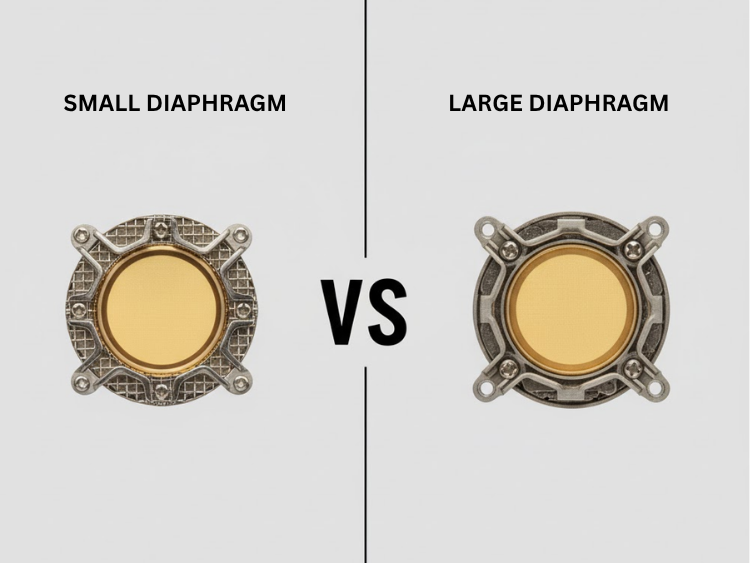
Ever set up a home studio or stepped into a pro booth and wondered why two microphones—both “condensers”—can sound worlds apart? The answer’s often hiding in plain sight: the size of the microphone’s diaphragm. That thin membrane transforms every voice, strum, knock, or room sound into electrical magic. And it’s not just an engineer thing—this one detail decides whether a vocal feels warm, an acoustic guitar glistens, or your drum overheads snap with life.
Mic diaphragm size—“small” vs “large”—is one of the first design choices that shapes a microphone’s sound. According to Neumann’s Homestudio Academy, a “large diaphragm” mic generally refers to diaphragms measuring 1 inch (25.4 mm) or more, while “small diaphragm” mics typically use membranes around ½ inch (12.7 mm) or less.
Large diaphragms usually offer lower self-noise and a fuller, warmer capture—ideal for vocals or rich solo instruments—while small diaphragms have faster transient response and flatter frequency accuracy, making them favorites for cymbals, acoustic strings, and stereo overheads.
Musicians are told to “trust their ears,” but it helps to know why different mics behave differently. Diaphragm size isn’t some old-school myth. It’s baked into every choice behind the mic: warmth vs. detail, character vs. honesty, and intimacy vs. air. Making sense of the difference saves time and delivers better tracks, right from the start.
How Large Diaphragm Mics Shape Sound
Large diaphragm condensers (LDCs) are typically defined by a capsule an inch (25mm) or more across. These are the go-to for vocals, big soloists, and sources that need a bit of extra roundness.
- They add weight and thickness to whatever they capture. Vocals come out lush, instruments get more “body,” and even a small amp takes on a bold, full sound.
- The bigger surface responds to subtle air changes, so low and mid frequencies sound enhanced. If you want your voice or cello to “sit forward” in a mix, this is the play.
- They’re forgiving—off-axis, off-headphone, or even if you lean, you still get a smooth, usable sound.
Best Use Cases:
Vocals, voiceover, amps, upright bass, solo strings, podcasting, and anything where presence matters as much as accuracy.
Where Small Diaphragm Mics Win
Small diaphragm condensers (SDCs) use capsules generally around 12mm or less. Their design reads as “pencil condenser”—narrow, fast, and precise.
- These mics act like the microscope of the mic world. Plosives, high notes, string attacks, drumstick clicks—they all come out crystal clear.
- The smaller the diaphragm, the faster it reacts, handling sharp attacks and transient spikes without breaking a sweat.
- While they don’t flatter or “hug” the source, they capture the real thing—especially in stereo pairs for acoustic sessions or as overheads for drums and cymbals.
Best Use Cases:
Acoustic guitar, piano, drum overheads, choirs, orchestras, bright room miking, stereo field recording, and anywhere subtlety rules.
Quick Comparison Table
| Characteristic | Large Diaphragm | Small Diaphragm |
| Size | ~1 inch or bigger | ~1/2 inch or less |
| Tone | Lush, warm, rich | Crisp, detailed, clear |
| Placement Needs | Forgiving | Precise, exact |
| Handles Loudness Well? | Good | Excellent |
| Common Uses | Vocals, soloists | Acoustic, overhead drums |
Which Should You Choose (and Why)?
The old rule is simple but effective: if you need “character,” reach for large diaphragm. If you want “truth,” lean small. Of course, pros often blend both to get the best of both sonic worlds.
A good studio keeps both types around—and serious home recordists do the same.
Try tracking the same source with each and compare: sometimes what felt like a “dull room” with one mic gets sparklingly alive with the other.
Final Thoughts
Diaphragm size isn’t just a spec sheet detail—it’s a fork in the road on every recording. Lean in, try a few, and judge with your ears in your own space. The results can truly be night and day, even with the same source and room.
Found a favorite diaphragm size for a particular sound or genre? Drop a comment or a tip for your fellow recordists—because the best studio hacks usually come from the real work, not just the manuals.
Here you can also find amazing drum thrones; alternatively, browse our page to find the best keyboard bench, audio mixers, drum mics, piano bench, keyboard stand, speakers, party speakers, and more.