

If you’ve ever watched someone drift in and out of audibility on stage, you already know how unforgiving speech can be. Unlike a rock vocal, a presentation lives or dies on consonants and clarity, not sheer power. Mics built with presenters in mind lean into that reality: they aim to keep voices intelligible when people talk instead of sing, forget perfect mic technique, and pace around a reflective room with a PA system pointed vaguely at their face.
The primary design element that makes a handheld microphone ideal for presenters is its directional pickup pattern, most often cardioid or supercardioid, which is crucial for achieving high gain-before-feedback in live sound environments. According to the audio publication Easy Music Center, a cardioid pattern offers maximum rejection of sound from directly behind the microphone, making it the most forgiving pattern when stage monitors are placed behind the speaker, a common setup for presenters. This directional focus ensures the microphone primarily captures the desired vocal source while significantly attenuating ambient noise and minimizing the risk of distracting acoustic feedback.
What Makes a Handheld “Presenter‑Friendly”
The first piece is the pickup pattern. Most presenter‑style handhelds use cardioid or supercardioid dynamics, which focus on sound from directly in front while pushing PA spill and audience noise into the sides or rear. That extra rejection is what lets a tech keep the voice louder than the room without hitting feedback every time the presenter walks near a speaker.
They’re also voiced with a gentle presence lift in the upper mids and some low‑end roll‑off—enough to make consonants pop and cut through slides, HVAC rumble, and crowd noise without making the voice harsh or boomy.
Then there’s the “feel” side. A good presenter mic has a solid metal body, a grille that shrugs off drops, and internal shock mounting so every grip change doesn’t turn into a thump through the PA. Weight and balance matter more than most people admit: too heavy and the mic is tiring to hold while gesturing; too light and it feels like a toy, which often leads to more fidgeting and handling noise.
Why So Many Presenters End Up on Wireless Handhelds
Cables are fine for a singer planted at center stage, but they’re restrictive for someone pacing, stepping into the audience, or working between multiple screens. Wireless handheld systems solve that by putting the transmitter in the mic body and sending audio to a receiver at the rack; a decent system gives enough range for conference rooms, churches, and small outdoor setups without dropouts as long as line of sight and basic frequency planning are respected.
Wireless also makes it easier to share the floor. In Q&A segments, panel discussions, or classrooms, a handheld can simply be passed to whoever is speaking. There’s no clipping on a lav, no headset to adjust, and no need to reroute cables mid‑session. The mic just changes hands, the channel stays live, and the event keeps moving.
Product Spotlights
5 Core Dual UHF Wireless Handheld Microphone Pair
Professional dual-channel UHF wireless microphone system operating in the 500-599MHz frequency range with digital PSK modulation and 48kHz sampling rate for clear, detailed vocal capture. Each handheld mic features a 30Hz-20kHz frequency response, ergonomic design with anti-slip rings, and rechargeable lithium batteries for extended use. The receiver delivers >105dB SNR, <0.5% distortion, 96dB dynamic range, and 2.5ms latency with up to 210ft range and auto-pairing. Includes 2 mics, USB charging cables, AA batteries, 6.35mm/3.5mm adapter, windscreens, and anti-slip rings.
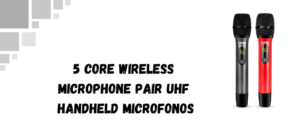
- Frequency range: 500-599MHz UHF, 30Hz-20kHz response
- Modulation: Digital PSK, 48kHz sampling
- Receiver specs: >105dB SNR, 60MHz bandwidth, 2*50 channels
- Range: Up to 210ft line-of-sight
- Power: Rechargeable lithium mics, BNC antenna
- Outputs: 6.35mm/3.5mm jack compatibility
- Build: Metal alloy mics/receiver for durability
Ideal for karaoke, live performances, speeches, and DJ setups needing dual mics with reliable wireless freedom.
Shure SM58 Dynamic Handheld Vocal Microphone
Industry-standard dynamic vocal microphone with cardioid polar pattern, 50Hz-15kHz tailored frequency response, and 126dB max SPL for clear, warm vocals with excellent off-axis rejection. Features built-in pop filter, internal shock mount, and all-metal construction for rugged stage durability. Weighs 298g (10.5oz) with 1.1″ diameter and 7.4″ length, includes mic clip and storage bag. No phantom power required; XLR connectivity.
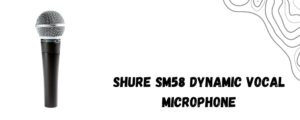
- Type: Dynamic cardioid handheld
- Frequency response: 50Hz-15kHz
- Max SPL: 126dB
- Dimensions: 7.4″ long x 1.1″ diameter
- Weight: 298g (10.5oz)
- Accessories: Mic clip, storage bag
- Build: All-metal body, shock-mounted capsule
The gold standard for live vocals since 1966, perfect for singers, presenters, and touring professionals.
Rockville RWM72U Dual UHF Wireless Handheld Microphone System
Dual UHF wireless system (exact frequency range varies by model, typically 902-928MHz or licensed bands) with 2 handheld mics featuring cardioid dynamic capsules for vocal clarity and feedback rejection. Offers up to 165ft range, mixed 1/4″ and XLR outputs on the receiver, LCD displays for channel/frequency, and auto-scan for interference-free operation. Mics use 2x AA batteries (8-10hrs life); includes receiver power adapter.
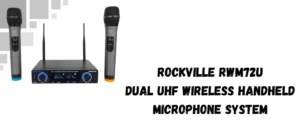
- Type: Dual UHF handheld wireless
- Range: Up to 165ft
- Outputs: Mixed 1/4″, individual XLR
- Features: LCD display, auto-scan, rack-mountable receiver
- Power: 2x AA per mic (8-10hrs)
- Build: Metal mics, plastic receiver
Great value dual wireless option for small venues, karaoke, and church/presentations needing a simple setup.
Helping Presenters Sound Good on Any of These Mics
Even the best handheld can’t fix habits on its own, so a bit of coaching goes a long way. Presenters should be encouraged to keep the mic roughly a fist away from the mouth, pointed directly at it—not at the ceiling or chest—and to avoid waving it around mid‑sentence. That one habit alone solves a lot of “it keeps cutting out” complaints that are really just level changes from inconsistent distance.
On the tech side, rolling off low rumble with a high‑pass filter, nudging down any harsh upper‑mid peaks, and keeping stage wedges out of the mic’s most sensitive pickup area will usually get you most of the way there. Do that, pair it with a presenter‑focused handheld that’s comfortable to hold and tuned for speech, and the gear fades into the background so the talk itself can do the heavy lifting.
Here you can also find amazing drum thrones; alternatively, browse our page to find the best keyboard bench, audio mixers, drum mics, piano bench, keyboard stand, speakers, party speakers, and more.